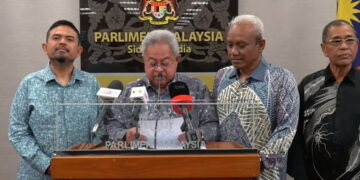


FEDERAL lawmakers are entrusted by the people to formulate laws. Yet, a group of Barisan Nasional (BN) MPs have appear to have turned their attention towards the Attorney-General’s Chambers (AGC) and the Legal Affairs Division over the declassification of minutes from a Federal Territories Pardons Board meeting concerning former prime minister Datuk Seri Najib Razak.
Yesterday (Nov 19), the MPs issued a 24-hour ultimatum demanding that the AGC confirm the authenticity of the minutes of the Sept 18 Pardons Board meeting, which allegedly contained details relating to Najib’s conditional pardon and a purported house arrest order.
The minutes had circulated online and were shared by former DAP lawmaker Tony Pua Kiam Wee on social media.
Ledd by Jempol MP Datuk Shamsulkahar Mohd Deli, the group questioned the authority under Section 2(c) of the Official Secrets Act 1972 to declassify the document, arguing that the proceedings and minutes of Pardons Board meetings are confidential.
The demand also comes amid calls for an investigation under the Sedition Act and Section 233 of the Communications and Multimedia Act 1998, as well as a proposed security audit and internal investigation by Chief Secretary to the Government Tan Sri Shamsul Azri Abu Bakar.
Legal Affairs Minister Datuk Seri Azalina Othman Said had previously addressed the issue, while Home Minister Datuk Seri Saifuddin Nasution Ismail said on Nov 12 that he would propose the declassification of the minutes.
But the MPs’ insistence on a confirmation within 24 hours raises questions about the purpose of the ultimatum, particularly when the matter involves legal and institutional processes that require proper examination.
If the concern is genuinely about transparency, legality and the exercise of authority, those questions ought to be pursued through established channels rather than deadlines imposed on government institutions through public pressure.
The controversy also sits within a wider debate over institutional reform, including the separation of the Attorney-General’s role from that of the public prosecutor. Such reforms have long been discussed as a means of strengthening institutional independence and accountability.
Media reports have indicated that the declassification was done by the AGC since it is an integral part of case documentation in a case that was filed by the Malaysian Bar.
The Malaysian Bar has also pursued legal action relating to the Pardons Board and the purported house arrest order, raising questions about the board’s powers and the legal basis of the order.
These matters, however, must be examined in their proper legal context rather than conflated with the separate question of the minutes’ classification status.
Had the group of BN MPs acted more strategically, they perhaps could raise the issue diplomatically without threatening the government agencies via the Special Select Committee on Human Rights, Elections and Institutional Reform in Dewan Rakyat.
Former UMNO supreme council member Datuk Dr Mohd Puad Zarkashi has also weighed in on the matter, with his criticism adding to the growing political debate surrounding the MPs’ demands.
Ultimately, if the Madani government is serious about institutional reform, its political partners and critics alike should be judged by whether they support the independence of institutions and due process, rather than whether they can compel a response within 24 hours.
The question is not simply whether the minutes should be declassified, but whether those demanding accountability are willing to uphold the same principles they invoke. – Nov 20, 2026.
Main image credit: Parlimen Malaysia/Youtube