

ASMalaysia pushes ahead with grid upgrades and household energy efficiency, the next question is how much solar power homes can actually use for themselves.
GoRental Global founder and managing director Colin Peh believes storage could become the missing link, but cost and accessibility will determine how quickly it scales.
Malaysia is committing billions of ringgit to strengthening its electricity system, but the next phase of the energy transition may play out inside individual homes.
Budget 2027 has put energy security and decarbonisation on the national agenda, including RM15 bil in investment by Tenaga Nasional Bhd (TNB) to strengthen the National Grid and RM1 bil under KWAP’s Dana Iklim+ for green projects.

The Budget also acknowledged rising household electricity consumption, with rebates of up to RM200 for energy-efficient air conditioners and refrigerators.
Yet between grid investment and more efficient appliances sits another question: what happens to the solar power Malaysian homes generate when they are not there to use it?
For Peh, that question is becoming more important under the Solar Accelerated Transition Action Programme (Solar ATAP).
“It changes the question from ‘how much can I export?’ to ‘how much of my own solar can I actually use?’” hetold Focus Malaysia.
When generation and consumption do not match
Solar ATAP is designed primarily around self-consumption while allowing households to export excess solar power to the grid.
Solar production typically peaks around midday, when many families are at work or school, while demand rises after sunset as air conditioners, cooking appliances and other equipment come into use.
That mismatch makes storage more relevant because a battery can hold part of the power generated during the day for use later in the evening.
In one Johor home recently surveyed by GoRental, the household was expected to consume around 55 kilowatt-hours (kWh) a day, with roughly 40 kWh of that demand occurring after dark.
Without storage, much of the daytime solar would be exported before the household needed it. Pehnevertheless cautions against oversizing a system from day one.
“The biggest lesson is to start with the load, not the product,” he said, adding that households should first identify what needs to keep running, for how long and how much electricity those essentials consume.
Affordability remains the hurdle
The case for storing solar may be clearer under Solar ATAP, but affordability remains a major barrier.
Pehsaid batteries can account for a significant share of the cost of a residential energy system, making a large upfront investment difficult to justify for many households.
Modular systems can lower the entry point by allowing homeowners to start with enough capacity for essential loads and expand later, while instalment plans, leasing and eventually energy-as-a-service models could widen access further.
There is also a less obvious cost for homes that already have rooftop solar. GoRental has found during recent site surveys that some existing installations use grid-tied inverters that cannot connect to a battery, meaning homeowners may need to replace relatively new equipment before adding storage.
Pehbelieves battery-ready hybrid inverters for new installations, incentives that recognise storage and pricing that rewards shifting demand away from peak periods would strengthen the financial case.
From commercial deployments to the home
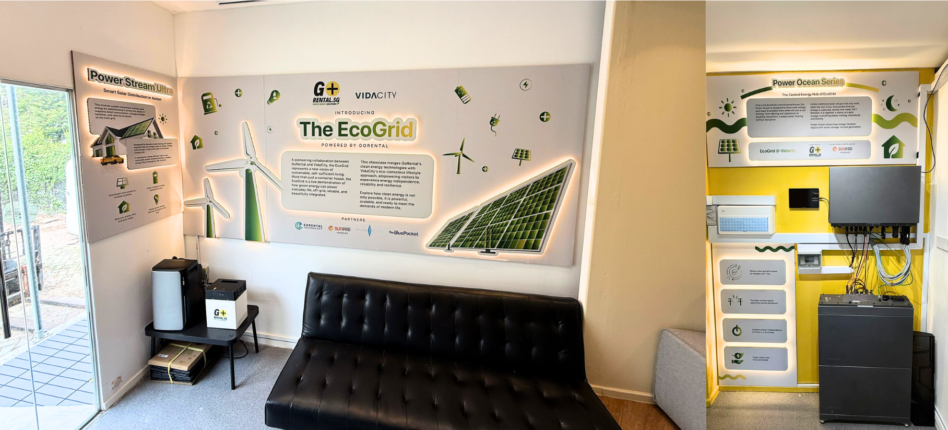
GoRental’s move into residential energy follows years of deploying batteries in commercial and community settings.
In2026, portable battery systems supported 48 booths, while its #PowerToEmpower initiative saw 10 solar-charged battery systems deployed for about 100 residents in Kampung Sat, Perak.
Those projects reinforced the idea that batteries do not need to replace every conventional power source to be useful.
“A battery doesn’t have to replace TNB; it needs to cover the essentials and shift solar into the evening,” Pehsaid.
The company is now bringing EcoFlow’s OCEAN 2 home energy system into Malaysia, combining rooftop solar integration, a hybrid inverter, modular lithium iron phosphate battery storage and home backup.
“Most residential solar in Malaysia was designed to export,” Pehnoted.
“The gap we see is a practical, locally supported way for households to use more of their own solar, protect the essentials during an outage and grow the system over time.”
For Peh, the hardware is only part of the equation. GoRental is positioning the offering around site assessment, system design, installation, commissioning and after-sales support, reflecting his view that home batteries should be treated as electrical infrastructure rather than another household gadget.
Existing wiring, installation location, battery chemistry, warranties and the choice of backup circuits all affect how safely and reliably a system performs. “Knowing who to call matters as much as the hardware specification,” he added.
Resilience may sell before savings do
While household solar is often discussed in terms of electricity savings, GoRental’s recent site surveys point to another motivation: resilience.
Homeowners have raised concerns about keeping refrigerators, water pumps, CCTV systems, autogates, Wi-Fi and other essentials running during disruptions.
A battery can switch to stored power when the grid goes down and, when paired with rooftop solar, recharge during daylight hours. “Resilience is often what convinces households first,” Peh said.
Over the longer term, wider adoption could also change the role households play in Malaysia’s energy system. If enough homes store daytime solar and use it during evening peaks, the collective effect could help reduce pressure on the grid.
With the right technical and regulatory framework, distributed batteries could eventually be coordinated to support the electricity system during periods of high demand.
Malaysia is still some distance from that scenario. Pehbelieves time-of-use tariffs, clearer technical standards, installer training and certification, and a long-term approach to battery recycling will be needed if the market is to scale responsibly.
For homeowners, however, the decision is more immediate: the technology has to fit the house, the economics have to make sense and someone has to remain accountable for the system long after installation.‒ Nov 24, 2026