

Aileen Anthony, Executive Editor, MALAYSIA SME, sits down with Dr Aaron Sum, Alliance Bank’s Group Chief Strategy and Transformation Officer, to better understand how the bank is helping SMEs in the manufacturing sector embrace sustainability.
A Malaysian spice manufacturer and the realities shaping ESG adoption among SMEs
“He manages his production line and quality controls on Discord,” Dr Aaron Sum said, illustrating the story of Gary Gan, Founder and Managing Director of Hexa Food, a Malaysian spice manufacturer navigating the complexities of food production. “Gary built an operational workflow that allowed scripts to communicate directly with machines while operators documented irregularities in real time, enabling batches to be isolated quickly before disruptions spread further into the production cycle.”
I can see why the example stayed with Dr Sum, who is Alliance Bank’s Group Chief Strategy and Transformation Officer, it challenged one of the most common assumptions surrounding sustainability and innovation among SMEs, that businesses associate ESG transformation with expensive infrastructure, major system overhauls and capital-intensive technology deployments.
“Gary’s approach demonstrated something far more relevant to most Malaysian SMEs. Operational resilience often begins with businesses rethinking how they work, tightening inefficiencies, improving traceability and strengthening decision-making at the ground level,” emphasised Dr Sum.
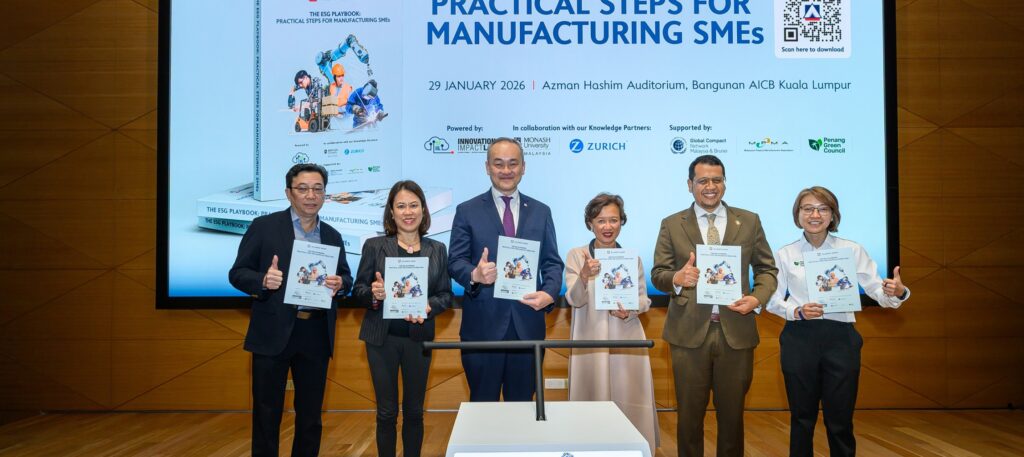
That philosophy anchors Alliance Bank Malaysia Berhad’s The ESG Playbook: Practical Steps for Manufacturing SMEs, the bank’s first sectoral ESG playbook designed specifically for Malaysian manufacturers, launched in January 2026.
ESG Meets the Realities of Manufacturing SME Survival
“This is a playbook by SMEs for SMEs,” Dr Sum explained. “This is not banker speak. This is not an ESG consultant telling you what to do.” The distinction matters because the manufacturing sector occupies a uniquely difficult position in Malaysia’s sustainability transition.
Manufacturing remains one of the country’s foundational industries, driving exports, industrialisation and employment while powering substantial portions of the broader supply chain ecosystem. Yet the same scale and interconnectedness that make manufacturing economically vital also make it one of the most complex sectors to address from an ESG standpoint.
And for many SMEs, the timing could hardly feel more difficult now. “SMEs are trying to survive and balance their books. In fact, not even balance books, just manage cash flow,” Dr Sum spoke about the pressures currently shaping SME decision making. Energy intensity, waste management, labour practices, operational efficiency and supply chain resilience now sit alongside traditional business concerns such as margins, productivity and market competitiveness.
The bank recognised early that ESG conversations could not remain theoretical if they were to gain traction among SMEs. “You can’t talk to a business owner about ESG without showing the link to their Profit & Loss.” That pragmatism became the foundation of the bank’s ESG roadmap, framed through three stages: the “Why,” the “How”, and the “What.”
The “Why” focuses on helping SMEs understand that ESG goes beyond compliance. Because Dr Sum shared, “Beyond regulations, ESG requirements extend into a business’ value chain, enabling SMEs to unlock efficiencies, meet stakeholder expectations, and build resilience in a rapidly evolving market.” See From the Playbook.
“In the initial part of the journey, we had to convince SMEs on why this is relevant. Today, we’re shifting the conversation significantly to the how.” The “How” led Alliance Bank toward more practical implementation support. The bank introduced the PROGRESS Climate Assessment Tool to help SMEs assess ESG maturity and identify operational gaps. Unlike broad sustainability frameworks detached from sector realities, the manufacturing playbook was intentionally structured around local case studies and operational examples specific to Malaysian SMEs.
The “How” of Sector-Specific Realities
Dr Sum explained that one of the biggest gaps in the “How” in Malaysia’s ESG ecosystem was the absence of relatable SME examples. “It’s a challenge finding local success stories at the SME level,” he said. The manufacturing playbook is enabling the bank to move beyond generic ESG discussions into sector-specific operational realities. “No single entity creates an ecosystem,” he added. The approach underpins the bank’s wider ESG strategy, particularly through the Innovation Impact Lab.
He explained that many SMEs already possess innovative ideas and workable technologies, but often struggle to scale because they lack technical validation, ecosystem access or commercial readiness. “On the other hand, there are innovative startups providing such solutions,” Dr Sum said. “But they may not be fully commercial-ready.”

Dr Sum elaborated further on how the broader ecosystem model functions, “There are larger corporations who may be keen to adopt holistic solutions into a project or strategy. These solutions now become very attractive because they align with larger corporations’ sustainability requirements.”
That dynamic forms a key part of Alliance Bank’s ecosystem model. Within the structure, knowledge partners Monash University Malaysia contribute research capabilities and validation frameworks and Zurich Malaysia contribute perspectives around derisking, protection gaps and operational safeguards within a sustainability landscape.
The wider ecosystem surrounding the initiative also includes the UN Global Compact Network Malaysia & Brunei (UNGCMYB), which helps ensure alignment with evolving international sustainability standards. Local industry bodies such as the Malaysian Plastics Manufacturers Association (MPMA) anchor conversations in the operational realities facing manufacturers, alongside councils such as the Penang Green Council (PGC) that provide industrial oversight and sustainability implementation perspectives closely tied to actual manufacturing practices. Additionally, Cradle Fund Sdn Bhd, an early-stage startup focal agency, enables grants and access to the startup ecosystem.
Beyond Banking
The bank recognises another barrier that’s slowing ESG adoption among SMEs, addressing a key hesitation many SMEs face when considering ESG-related investments. Businesses are often approached by multiple vendors offering sustainability solutions, but without the technical expertise or resources to independently assess those offerings, decision-making can be difficult and adoption slows.
For this, the bank builds a “beyond banking” ecosystem designed to shift the conversation from financing to implementation support. “When an SME client comes to us, we offer advice as to whom they could possibly link their business with,”Dr Aaron Sumexplained, referring to the bank’s growing network of vetted solution providers spanning energy efficiency, operational optimisation and renewable energy integration.The bank conducts due diligence on providers operating within its ecosystem, allowing SMEs to engage vendors with greater confidence. “SME business owners can contact the bank to make an appointment to speak with us and we will guide them through the process.” he assured.
From the Playbook:How can ESG Enhance Each Stage of the Value Chain?
Environmental, Social and Governance (ESG) principles are increasingly enhancing the manufacturing value chain, sequence of activities, processes and stakeholders involved in creating, producing, delivering and supporting a product or service from raw materials to the end customer.
Procurement and Sourcing
At the upstream level, ESG strengthens procurement and sourcing functions by improving supplier quality, reliability and long-term resilience. Traditional procurement models focused primarily on cost and speed, but ESG integration encourages manufacturers to prioritise suppliers that meet environmental, ethical and governance standards.
Sustainable sourcing practices, fair trade considerations, responsible material selection and consolidated logistics planning reduce environmental impact and improve supply chain stability and reduce reputational risks.
Manufacturers that embed ESG principles into procurement are often better positioned to meet the requirements of global buyers while improving access to financing and strengthening their entry into premium international markets.
Operations
Within core manufacturing operations, ESG enhances operational efficiency by driving resource optimisation, productivity improvements and stronger workforce management. Manufacturing environments are traditionally resource-intensive, particularly in energy usage, raw material consumption and waste generation.
ESG integration encourages manufacturers to adopt energy-efficient machinery, implement lean manufacturing principles, strengthen workplace safety standards and improve packaging sustainability. These measures reduce environmental impact while lowering operating costs, improving product consistency and strengthening workforce retention. ESG, therefore, becomes closely tied to operational discipline and long-term production competitiveness rather than functioning solely as a reporting exercise.
ESG also transforms waste and resource management from a reactive compliance function into a value-generating component of the business. Under traditional manufacturing models, waste management was often treated as a necessary operational cost focused mainly on disposal. ESG frameworks encourage manufacturers to adopt circular economy practices such as reprocessing defective goods, implementing closed-loop recycling systems and reducing dependency on virgin raw materials.
These initiatives minimise waste volumes, reduce disposal costs and improve alignment with environmental regulations. At the same time, manufacturers can unlock additional value through material recovery, lower raw material costs and reduced exposure to reputational and legal risks associated with poor waste management practices.
Distribution and Delivery
Further downstream, ESG enhances distribution and delivery systems by improving logistics efficiency, reducing emissions and strengthening market access. Transportation and warehousing remain major contributors to supply chain carbon emissions, prompting manufacturers to adopt greener logistics practices such as renewable-energy-powered warehousing, solar-integrated storage facilities, and electrified transport fleets.
Compliance with international standards such as Restriction of Hazardous Substances (RoHS) and Registration, Evaluation, Authorisation and Restriction of Chemicals (REACH) also strengthens manufacturers’ ability to participate within highly regulated export markets. These improvements reduce fuel and energy costs while enhancing delivery performance, operational efficiency and long-term competitiveness within sustainability-driven global trade environments.
Ultimately, ESG integration enhances the manufacturing value chain by improving how businesses operate across procurement, production, waste management and logistics simultaneously. Manufacturers that embed ESG principles into each stage of the value chain are not only reducing environmental impact, but also strengthening resilience, improving profitability, enhancing operational continuity and positioning themselves more competitively within evolving global supply chains.
Refer to the Playbook for details.