






KUALA LUMPUR: Data centres now account for around 50% to 55% of Panduit’s business in Malaysia, as the rapid expansion of artificial intelligence (AI) and data-centre infrastructure has shifted the company’s local revenue mix over the past two years.
Panduit senior business manager for Malaysia, Singapore and Indonesia, network infrastructure unit, Kevin Choong, said growth in the company’s Malaysian business over the past two years had been driven largely by data centres, with AI expected to be the fastest-growing segment of the market.
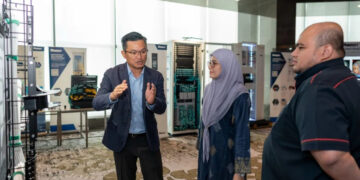
“The growth actually this past two years is all from data centre. You see more data centre than I don’t know, I maybe use a comparison, maybe building. You see data centre built faster than the building these days, right? So naturally, our revenue has shifted a lot to data centre right now,” he said during a media briefing at Panduit Technology Day Malaysia here yesterday.
Choong said data-centre business now represents “somewhere around 50 to 55%” of Panduit’s Malaysian business, with the remainder coming from sectors including manufacturing, semiconductors and commercial buildings.
He expects AI to be the fastest-growing segment of Malaysia’s data-centre infrastructure market, as increasingly compute-intensive workloads drive demand for higher-capacity computing, connectivity and supporting infrastructure.
Malaysia continues to attract large-scale investments in data centres and cloud infrastructure, with the Malaysian Investment Development Authority (Mida) reporting RM34.6 billion in approved investments across 33 data-centre and cloud-computing projects in the first quarter of 2026.
The rapid build-out is also changing buying priorities, with customers increasingly focused on delivery speed amid tight supply conditions.
“At least these days, the number one challenge that we are facing every day is about the customer’s request that we need to deliver instantly. Price, secondary. I want your lead time to be fastest possible,” said Choong.
Panduit business director for Asean, India and Korea, Simin Sirun, said the company’s Johor manufacturing facility was also experiencing strong demand.
“The factory is very busy right now because of the whole demand that’s shaping right now, he added.
“A lot of demand is so high, and then at the same time, you can’t supply. So we are facing right now to work through all this transition, and we are trying to work through to try to ensure our customer is happy with what we can deliver at this point of time.”
Sirun said supply-chain constraints were also affecting the industry, particularly as AI infrastructure demand accelerated.
“Everybody knows there’s a shortage of fibre glass, and securing the material is very critical,” he added.
The Johor facility supplies both the Malaysian market and customers globally as part of Panduit’s wider manufacturing network.
The company has nine factories worldwide, including two in Asia-Pacific.
Choong said Panduit works across Malaysia’s data-centre ecosystem, serving developers, contractors, hyperscalers and enterprise customers. The financial-services sector also remains an important customer base.
“All the major banks in Malaysia are actually our existing customers, and we have been working with them for the past 20 years at least,” Choong said.
Panduit works with about 45 Malaysian companies through its partner ecosystem, comprising mainly system integrators and other infrastructure partners that support installations and deployments across enterprise data centres, manufacturing facilities and financial-services customers.
Choong said Panduit’s positioning in the data-centre market was primarily focused on network infrastructure and connectivity, complementing other infrastructure providers.
“Vertiv, Schneider, they are playing in those low-voltage environment, right, where they are the power professionals for the data-centre facilities.
“Whereas, we are the network infrastructure, cabling solutions provider that complements the whole entire complete build-up of the DC.”
- Latest
- Trending