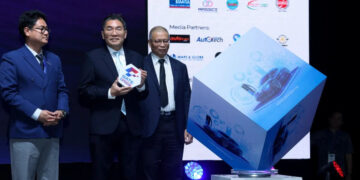












KUALA LUMPUR: The domestic automotive industry must move beyond just vehicle assembly and serve as a powerful economic engine that drives high-value activity, elevates local vendors, sharpens domestic engineering capabilities and accelerates technology transfer across the nation’s economy.
Investment, Trade and Industry Deputy Minister Sim Tze Tzin said under the New Industrial Master Plan 2030, Malaysia is already moving beyond traditional assembly to become a high-value regional hub for innovation, research and development (R&D) and advanced manufacturing.
“As one of the world’s premier semiconductor hubs, Malaysia is uniquely positioned at the convergence of automotive engineering and electronics.
“Miti (Ministry of Investment, Trade and Industry), through the Malaysia Automotive Robotics & IoT Institute (MARii) and the Malaysian Investment Development Authority, is actively driving partnerships in automotive chips, electric motor powertrains, software and battery technologies,“ he told delegates at the Global Automotive Technology Expo 2026 (GATE 2026) today.
However, to ensure this transformation is sustainable, Sim said, the industry must deepen local integration, adding that Malaysia is not competing to be the cheapest assembly site.
“We seek true, long-term strategic partners. Therefore, the government strongly urges foreign original equipment manufacturers and global investors to build deeper, meaningful linkages with our local vendor ecosystem.”
Further, Sim said deep integration with Malaysian vendors offers two clear strategic advantages.
“Through our New Incentive Framework and the upcoming revised incentive mechanism, the government will directly reward companies that commit to higher local content, local R&D, and technology transfer.
“On top of that, by developing and relying on local Tier-1 and Tier-2 suppliers, global players gain a highly stable, agile, and cost-effective domestic supply chain protected from global geopolitical disruptions.”
On the domestic front, Sim pointed out that Malaysia’s total industry volume (TIV) for 2025 hit an all-time high of 820,752 units – surpassing the 800,000-unit mark for two consecutive years.
Building on this momentum into the first half of 2026, total vehicle sales rose 3.1% year-on-year to 385,353 units.
In light of this stronger-than-expected performance, the Malaysian Automotive Association has revised its full-year TIV forecast upwards to 800,000 units.
Apart from that, the battery electric vehicle sales surged by 106% year-on-year to 26,192 units, surpassing hybrid sales for the first time and accounting for 6.8% of the total vehicle sales.
“The transition towards electrified mobility must be managed in a balanced and inclusive manner.
It must consider consumer affordability, infrastructure readiness, energy security, environmental sustainability and the capacity of local businesses and workers to participate in the new value chain,“ Sim said.
MARii chairman Datuk Dr Aminar Rashid Salleh said electric vehicles are increasingly part of the Malaysian everyday mobility landscape, and artificial intelligence is being integrated into vehicle development, manufacturing and aftersales services.
“Connected and increasingly autonomous technologies are changing how vehicles interact with drivers, infrastructure and their surroundings.
“At the same time, the growing presence of Chinese automotive brands is adding a new dimension to Malaysia’s mobility landscape, particularly in electric vehicles and intelligent technologies.
“Beyond introducing new models, their participation also creates opportunities for investment, localisation, technology exchange and supplier development, reflecting the potential for deeper collaboration with Malaysian companies,“ he said.
Aminar Rashid said as MARii chairman, he has the opportunity to re-engage with the industry from a broader perspective, meet local automotive companies, vendors and technology providers, and see firsthand the capabilities that already exist within Malaysia and the potential that can be unlocked when these capabilities are properly connected.
“Together with MARii’s board, management and dedicated team, we have sought to strengthen the Institute’s role as a bridge between government policy, industry requirements, technological advancement and talent development,“ he added.
Aminar Rashid said he, having witnessed several phases of Malaysia’s automotive development, has learned that technology may change, but the industry’s fundamentals remain the same.
“Progress requires capable people, strong local companies and partners who are willing to work together.
“Malaysia has built a solid automotive foundation, but our next phase will depend on how quickly we adapt and how confidently we enter new areas of growth,“ he said.
GATE 2026 opened with a strong call for Malaysia to deepen localisation, accelerate technology adoption and position itself as a leading automotive and intelligent-mobility hub in Asean.
The three-day event, which runs until Friday, features the exchange of memorandums of understanding between international and Malaysian companies.
The collaborations demonstrate GATE’s role in connecting global expertise and technologies with Malaysia’s industrial capabilities, creating opportunities for technology transfer, localisation, supply-chain development, investment and access to new markets.