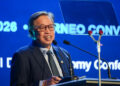


KUCHING: Sarawak is pushing to commercialise its technology capabilities and capture greater economic value by strengthening the links between research, industry, investment and markets, as the state seeks to turn innovation into businesses, products and services that can compete beyond its borders.
Sarawak Premier Tan Sri Abang Johari Tun Openg said the next phase of the state’s digital economy would require stronger links between research, industry, investment and markets so that technological capabilities could translate into tangible economic value.
Sarawak’s objective was no longer simply to gain access to a larger regional market, but to contribute to that market through capabilities, enterprises and knowledge developed locally, he added.
“The question is no longer simply what technologies are emerging, but how do we build the capabilities and ecosystem that allow Sarawakian ideas, businesses and knowledge to grow here, connect outward, and scale beyond our borders,” he said in his keynote address at the International Digital Economy Conference Sarawak 2026 here today.
Sarawak is positioning itself within a wider regional digital economy, with the Asean Digital Economy Framework Agreement (Defa) and the continuing development of the Asean Power Grid expected to strengthen the movement of data, energy, capital, knowledge and services across borders.
Abang Johari said Asean’s digital economy could reach as much as US$2 trillion by 2030 with successful implementation of Defa.
Against this backdrop, he added, the Sarawak Artificial Intelligence Centre is playing a central role in developing the state’s AI capabilities, talent, applications and trusted infrastructure, while the Sarawak AI Blueprint 2026-2030 is being developed to provide a coordinated approach to AI development across government, industry, academia and research.
The Sarawak Sovereign AI Infrastructure Platform, launched in August, is intended to establish a locally governed environment for AI computing and the secure management and protection of strategic government data.
Sarawak will also develop the Kuching AI Data Campus in Tanjung Embang as a catalyst for the next phase of its AI ecosystem.
The campus will have dedicated power and water infrastructure, AI computing facilities and digital connectivity nodes, and will be developed through a public-private partnership approach.
Abang Johari said the campus would provide the physical foundation for an AI Grid while helping to attract investment, strengthen the data-centre ecosystem and support the growth of AI-related businesses and capabilities.
“Alongside this, the AI Grid is being developed to connect computing resources and make use of Sarawak’s renewable energy capacity,” he added.
One example of how technology developed for the government could have wider commercial applications is ADAM AI, developed for the Sarawak Civil Service to work with authorised information, support policy analysis, prepare documents, assess scenarios and support decision-making.
Abang Johari said the potential of such capabilities extended beyond the government and the same capabilities can also be adapted across industries where Sarawak has distinctive needs and strengths.
Semiconductors would be an important area in this transition because the technology underpins AI, advanced computing, telecommunications, advanced manufacturing, energy systems and aerospace.
Sarawak already has an industrial presence in the sector, while its Semiconductor Roadmap 2030 provides a pathway towards higher-value activities such as chip design, specialised engineering, research and talent development.
He cited the development of gallium nitride-based semiconductor technology as an example of locally developed technology being applied in intelligent power-conversion systems.
“The opportunity is to move from semiconductor and chip design into practical applications,” he said.
Ultimately, he said, these capabilities must translate into value in the real economy by addressing industry challenges, strengthening existing sectors and creating opportunities for Sarawakians.
Sarawak is also looking beyond terrestrial technologies, with an aspiration to develop its first nanosatellite by 2030 using CubeSat technology.
However, Abang Johari said the value of the satellite would not simply be in putting it into orbit.
“The value is not simply in the satellite itself. It is in the data and information it can provide, including Earth imagery, geolocation and strategic information that can support planning, environmental monitoring, resource management and many other applications.”
Applications could include agriculture, forestry, environmental management, disaster response and natural-resource management, while also creating opportunities in research, engineering and new businesses.