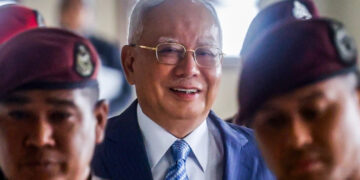


The DAP’s call for the declassification of the minutes of the Federal Territories Pardons Board (FTPB) meeting that granted former Prime Minister Najib Razak a partial royal pardon raises an interesting question: what is the party really hoping to achieve?
Najib was jailed in 2022 after the Federal Court upheld his conviction in the RM42 million SRC International case involving abuse of power, criminal breach of trust and money laundering. He was sentenced to 12 years’ imprisonment and fined RM210 million.
In 2024, the then Yang di-Pertuan Agong halved his prison sentence. Subsequently, in September 2026, the Pardons Board, chaired by the Yang di-Pertuan Agong, Sultan Ibrahim, granted Najib a conditional pardon involving house arrest and the payment of RM50 million.
From the beginning, DAP opposed a royal pardon for Najib, maintaining that he should serve his punishment for the crimes he had committed.
The question, however, is why DAP is now so keen to have the minutes of the Pardons Board meeting declassified.
Perhaps the party’s leadership wants to establish the actual position taken by government representatives on Najib’s pardon.
Minister in the Prime Minister’s Department (Federal Territories) Hannah Yeoh has given the impression that she defended DAP’s position and did not consent to Najib being granted a pardon.
However, there may be doubts within certain quarters of DAP about whether the party’s position was adequately represented at the meeting.
Although DAP is part of the federal government, this does not necessarily mean that its representatives or other government representatives took a position consistent with the party’s opposition to Najib’s pardon.
There may be concerns that those representing the government had, in fact, approved or supported the partial pardon.
By demanding the release of the minutes, DAP may hope to demonstrate publicly that neither the party nor its representative consented to Najib’s pardon.
In this sense, the demand could also be an attempt to clarify the party’s political position and distance itself from a controversial royal decision.
Nevertheless, declassifying the minutes of the Pardons Board is easier said than done.
Apart from obtaining the necessary clearance from the Attorney-General, the government would have to consider the political and institutional consequences of making such confidential proceedings public.
Since the Pardons Board was chaired by the Yang di-Pertuan Agong, the government must exercise considerable caution. It would not want the disclosure of the minutes to become a political controversy that could undermine or politicise the royal institution.
Chances are that the minutes may never be declassified. Yet DAP’s demand serves a political purpose: it gives the public the impression that the party and its representatives never consented to Najib being granted a royal pardon.
In other words, the call to declassify the Pardons Board minutes may be little more than a public relations exercise by DAP, intended to protect its political credibility without necessarily resulting in any meaningful disclosure. – Nov 3, 2026
Main image credit: Malay Mail
Former DAP stalwart and Penang deputy chief minister II Prof Ramasamy Palanisamy is chairman of the United Rights of Malaysian Party (Urimai) interim council.
The views expressed are solely of the author and do not necessarily reflect those of Focus Malaysia.