


INFORMATION communications technology (ICT)-savvy content creators and finfluencers are increasingly warning Malaysians to stay alert against abrupt downloading of text messages – or even spam e-mails – which will only open doors to hackers to access their personal banking information.
Such clarion call seems to come hot on the heels of escalating cyberattack concerns after a coordinated cyberattack hit commercial refrigeration and cold-storage infrastructure across more than 10 European countries and US military bases with millions of euros in food spoilage from the spiking of freezer and cooler temperatures.
‘Alert guys!! Cyberattack has started in Malaysia. If you receive a text like this (with ZIP file attachment), don’t download and run!” cautioned planning engineer-turn-software developer Muhamad Fauzi Yahaya (@fauziyahaya).
Set on your WhatsApp to disable auto download. Report it directly to that number, it’s a scam! Mass WhatsApp texts are being blasted!
If you’re affected, your device has been compromised! Alert with bank notification if there’s sudden money coming out!
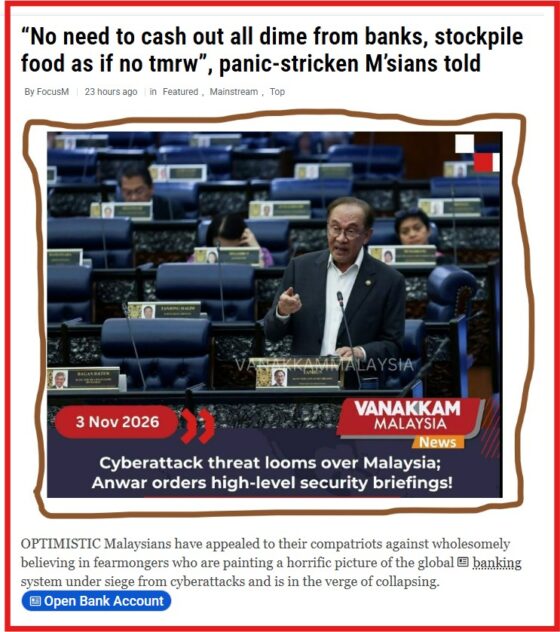
Editor’s Note: Prime Minister Datuk Seri Anwar Ibrahim had on Tuesday (Nov 3) given more credence to cyberattack incidences with his claim that Malaysia is among the countries considered potential targets of cyberattacks.
In so doing, he further alluded to the shutdown of Belgium’s national tax portal, the compromise of identity records of almost nine million Danes, a 41-hour disruption to the US Federal Election Commission’s filing system and exposure of the personal records of more than 100,000 Japanese police personnel.
Following this, some social media influencers are riding on the shockwave by casting extreme fear on faint-hearted Malaysians – eg the banking system is on the verge of collapsing – rather than teaching them practical precautionary measures to better safeguard their bank accounts.
Hence, the call to withdraw bank savings all at once due to “panic” from a potential cyberattack has led to allegations of fearmongering by so-called optimistic Malaysians.
A single mis-step can be costly
The most basic form of cyberattack or otherwise, finfluencer Pelabur Bijak (@pelabur_bijak) also warned that “cyberattack has already infiltrated Malaysia’s WhatsApp users”.
Pointing to ZIP file attachments, he sternly cautioned against clicking them.
“Verify first with the sender even if he’s a good friend of ours,” insisted the economy and financial-savvy poster.
“Always ask first before downloading and opening. Once you open, your WhatsApp account will be compromised with the virus transmitting the similar file to all your contacts using your account.”
Aside from the Meta Platforms-owned free global instant messaging, voice and video calling application, conventional e-mail accounts, too, are not spared either with Threader Pinoi Buk (@pinoi_buk) sharing of “being spammed with hundreds of tax-related documents with attachments to download”.
“Cyberattack is happening in Malaysia; guys be careful by don’t simply downloading any file!!!” warned the self-proclaimed buyer of used gold/jewellery pawn ticket.
“This is very surprising given that I only submit my income tax through the official website yet I was bombarded with lots of files … so worrying … hmm take care guys!!!”
Interestingly, it is a subjective matter if the cry of “cyberattack has hit Malaysian shores” is tantamount to being a form of fearmongering as highlighted by Threader Mont Kiara Uncle (@vincentchin88)
“Guys, the Whatsapp zip malware has been happening in different iterations for weeks already. It’s not from yesterday. No need to show you didn’t know by announcing today “cyberattack dah mula (cyberattack has started),” chided te businessman.
“The malware with the zip file typically activates from your Windows Whatsapp when you open the file. The payload then runs from your computer and hijacks it. Just remember to keep your Windows anti-virus updated and don’t download to your computer.” – Nov 5, 2026
Main image credit: Jharkhand State News