

KUALA LUMPUR – Malaysian businesses are adapting to trade uncertainty and disruption, with 88% saying their actions have been effective, according to HSBC’s Global Trade Pulse Survey 2026, which surveyed 10,000 businesses across 26 markets, including 250 Malaysia-based companies.
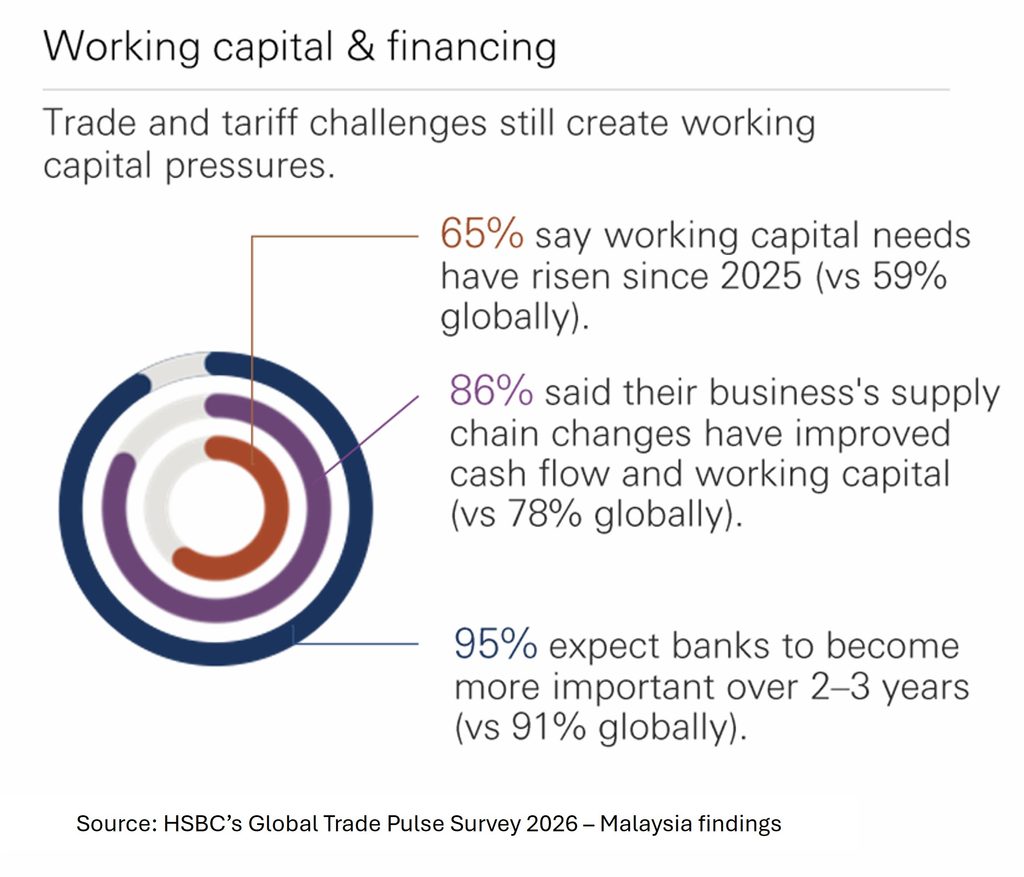
More than eight in ten (86%) say supply-chain changes made by their business have improved cash flow and working capital, above the global average of 78% and close to the ASEAN average of 88%. Businesses are also building resilience through higher inventories, with 53% of Malaysian firms saying they have increased stock levels to manage disruption, compared with 43% globally.
Malaysian businesses also remain confident in their ability to grow international trade over the next two years. Some 86% are confident they can grow international trade over that period, in line with the global average, even as businesses continue to face trade uncertainty and rising costs.
Shreyas Krishna, Head of Global Trade Solutions, HSBC Malaysia comments “What stands out in the Malaysia findings is the disciplined way businesses are responding to continued trade uncertainty. They’re making considered changes to their supply chains and cash-flow management to strengthen day-to-day resilience and support future growth.”
Costs Expected to Rise the Next Two Years Despite Being the Greatest Pressure on Businesses’ Cost Bases
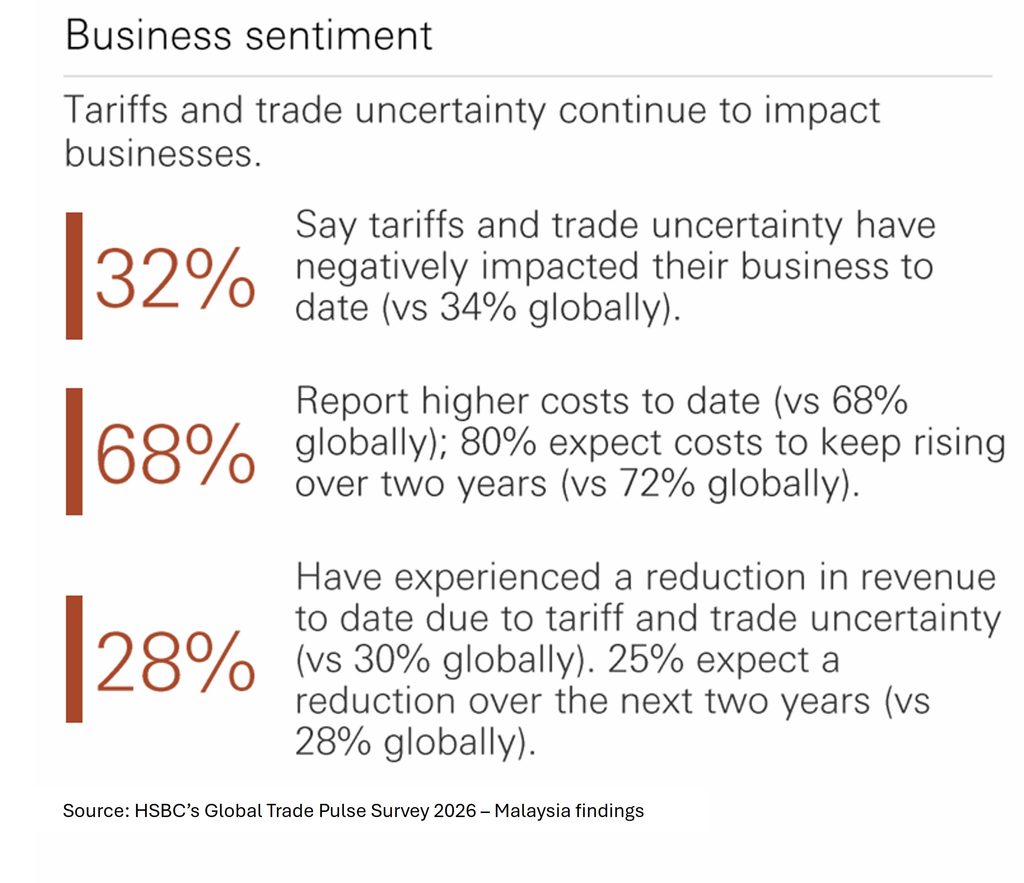
80% of Malaysian businesses expect costs to rise further over the next two years above the global average of 72% and slightly ahead of the ASEAN average of 79%, while 68% say they have already experienced higher costs.
Globally, energy costs were the most cited pressure on businesses’ cost bases over six months (44%), followed by tariffs and custom duties ($3%), freight costs (41%) and raw materials (39%). In Malaysia, businesses reported especially high pressure from freight and raw materials, both cited by 55% of respondents, as well as energy costs at 53%. 32% of Malaysian-based businesses say tariffs and trade uncertainty have negatively affected their business to date, while 28% report a reduction in revenue.
Southeast Asia is the region Malaysian businesses are relying on the most, with 72% saying so, compared with 66% across ASEAN and 44% globally. That regional focus is also visible at market level, where the markets they are increasingly reliant on the most are Malaysia (54%), Singapore (52%), and Indonesia (41%). Simultaneously, Malaysia is becoming more important within regional trade networks, with businesses in Bangladesh (41%), Singapore (39%), and Indonesia (38%) among those most likely to say they are increasing their reliance on Malaysia.
FRee Trade Agreements (FTA) remain central to international growth strategies. In Malaysia, 94% of businesses use at least one FTA, broadly in line with the global average of 95% and the ASEAN average of 97%. However, only 6% of Malaysian businesses say they face no significant barriers to making greater use of FTAs.
AI’s Involvement in Trade-Related Activity and Working Capital Needs Are Rising
In Malaysia, 87% of businesses have deployed AI in at least one trade-related function, above the global average of 85%, while 93% have adopted or plan to adopt AI tools. On average, Malaysian businesses have put in place just over four of the 10 AI governance measures tracked in the survey, compared with three and a half globally.
Working capital needs are also rising. 65% of Malaysian businesses say their working capital requirements have increased since 2025, above the global average of 59%. Simultaneously, 95% expect banks to become more important over the next two to three years, compared with 91% globally.
“Businesses are also taking a more deliberate approach to growth by strengthening regional trade links, expanding digital channels and making better practical use of existing free trade agreements, including ASEAN trade agreements and the China-ASEAN Free Trade Area.”
“While formal market access is in place, there’s still scope to turn it into greater day-to-day commercial benefit. In a more uncertain trading environment, trusted banking partners such as HSBC can help businesses manage liquidity, investment and growth with confidence.” Krishna added.