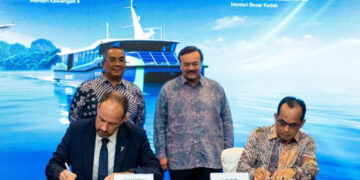


PUTRAJAYA: Yinson Holdings Bhd’s green technology arm Yinson GreenTech and Langkawi Port Sdn Bhd (LPSB) will pilot Malaysia’s first commercial, open-sea, point-to-point, fully electric passenger ferry service between Langkawi and Kuala Perlis.
The pilot will involve two fully electric ferries, each capable of carrying 100 passengers, with Yinson funding the project internally.
LPSB will operate the service while Tenaga Nasional Bhd (TNB) will develop the power and charging infrastructure.
Yinson Holdings chief of staff Liaw Thong Jung said the project would be developed as a public-private initiative involving Yinson, LPSB and TNB.
“For this project, we will provide two electric ferries connecting Langkawi with Kuala Perlis,” he told a press conference at the MoU signing ceremony today.
Liaw said the project is currently internally funded, but government policy and support would be important in accelerating the development of electric maritime transport in Malaysia. “For now, the project is internally funded. But if we look at other countries that have developed electric ferries, government policy is very important in advancing electric maritime transport.”
He cited Norway and China as examples of countries where government grants and incentives had supported the adoption of electric ferries.
“We hope this pilot project can become a blueprint for the country to further develop the infrastructure and regulations for electric ferries,” he said.
The proposed service is based on marinEV’s Hydroferry platform, which incorporates electric propulsion, onboard energy storage, integrated digital technologies and autonomous and remote-operation capabilities developed by Zeabuz.
The vessels will use fast-charging technology, with charging expected to take about one hour based on current estimates.
Liaw said the two vessels would be built in China for the pilot, with Yinson looking to transfer the relevant skills and expertise to Malaysia to support the development of local shipbuilding capabilities. “The builder of the ferry is in China, but we can bring back all these skill sets so that shipyards in Malaysia can one day build such infrastructure.”
The electric ferry service will be positioned as a premium offering, with ticket prices yet to be finalised.
The service is expected to add capacity to the existing Langkawi-Kuala Perlis route rather than replace incumbent operators.
“This project will complement existing ferry operators. It will not take over from them. Instead, we will increase the number of trips between Langkawi and Kuala Perlis,” Liaw said.
LPSB general manager Muhd Nasir Abdul Aziz said the fleet schedule was still being finalised, with at least six trips a day from Kuala Perlis to Langkawi currently envisaged, subject to operating conditions at both jetties.
He said the project represented an initial step towards introducing electric technology into Malaysia’s maritime sector and would require coordination across vessel construction, technology, safety and regulatory requirements.
“We do not see this as merely the development of an electric vessel, but as an initiative requiring the involvement and coordination of many parties, from vessel construction and technology to safety and regulatory aspects of ferry operations,” he added.
Liaw said electric ferries could offer lower maintenance costs than conventional internal combustion engine (ICE) vessels while reducing exposure to diesel-price volatility. “Maintenance costs for electric ferries are indeed lower compared with ICE ferries. The use of electricity would provide greater cost stability by reducing reliance on diesel and exposure to diesel-price volatility.”
He added that reducing reliance on diesel could also lessen the burden of fuel subsidies on the government.
However, Yinson has yet to disclose the total investment cost of the pilot, expected maintenance savings, electricity costs or overall operating-cost savings compared with conventional diesel-powered ferries.
TNB will develop the charging infrastructure as part of the three-party public-private initiative.
The project has been designated a National Priority Project and is supported by the Ministry of Transport, the Ministry of Finance and the Marine Department of Malaysia.
The parties will work with relevant government agencies, infrastructure providers and other stakeholders on the technical, operational, regulatory and commercial requirements for implementation.
Liaw said the pilot could provide a foundation for further electric maritime projects in Malaysia and the region by giving the company experience in operating fully electric passenger vessels and the supporting infrastructure in a commercial setting.
“As a pilot project, we hope this will be a success and subsequently become a launchpad for other electric maritime projects,” he added.
For marinEV, which is Yinson GreenTech’s marine electrification business providing electric vessel solutions for the maritime industry, the Hydroferry represents an expansion into passenger transportation following the development of its Hydromover cargo vessel and Hydroglyder crew-transfer platforms.
Hydromover has progressed from technology development and trials into commercial operations in Singapore.
The project will complement existing connectivity between Langkawi and mainland Malaysia while supporting Malaysia’s broader energy transition and maritime decarbonisation ambitions.
The National Energy Transition Roadmap identifies marine transport as an area for decarbonisation and targets 40% green-fuel penetration in the sector by 2050.