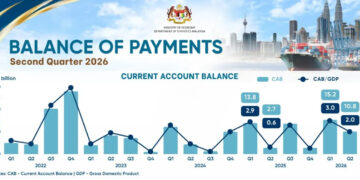












PETALING JAYA: Malaysia’s current account balance (CAB) recorded a surplus of RM10.8 billion in the second quarter of 2026, according to the Department of Statistics Malaysia (DoSM).
The position was primarily supported by a substantial increase in the goods surplus to RM40.7 billion, which cushioned the decline in the services account as it turned into a deficit of RM0.7 billion from a surplus of RM6.4 billion in the previous quarter.
Meanwhile, the financial account reversed to a net outflow of RM27 billion, contributed by outflows in portfolio investment amounting to RM35.2 billion.
Foreign direct investment (FDI) narrowed to a net inflow of RM7.4 billion, whereas direct investment abroad (DIA) outflows moderated to RM7 billion, reflecting reduced cross-border investment activities by Malaysian companies.
The current account surplus in the second quarter of 2026 was supported by continuous strong demand for electrical and electronic (E&E) products, petroleum products and machinery, equipment and parts, particularly from the United States, Singapore and China.
Similarly, imports of goods increased by 21.7% quarter on quarter to RM318.6 billion. The major contributors of imports consisted of intermediate goods and capital goods predominantly from China, Singapore and Taiwan.
The services account, meanwhile, returned to a deficit of RM700 million in the second quarter of 2026, following three consecutive quarters of surpluses since the third quarter of 2025 (Q3 2025: surplus RM2.7 billion).
The turnaround was particularly driven by a substantial widening in the deficit of other business services, from RM1.9 billion to RM8 billion, due to higher imports of professional and management consulting services.
Despite the narrower travel surplus, which declined from RM14.1 billion to RM13.2 billion in this quarter, travel continued to be the largest export component, totalling RM30.7 billion or 37.5% of total services exports. This was mainly attributable to a slight decrease in travel exports, while travel imports remained significant, reflecting continued spending by Malaysians abroad.
Nevertheless, the impact of the deficit was partly cushioned by improvements in telecommunications, computer and information services, which recorded a higher surplus of RM2.1 billion, as well as manufacturing services on physical inputs owned by others, which grew to RM5.9 billion.
The primary Income account posted a higher deficit of RM27.2 billion compared with the preceding quarter. The wider deficit was largely influenced by the increased earnings generated by foreign investors in Malaysia, which rose to RM47.2 billion.
Conversely, Malaysian companies abroad earned a higher income of RM22.8 billion, following a rise in dividend repatriation by direct investors over the quarter.
Concurrently, the secondary income account deficit narrowed to RM2.1 billion from RM4 billion in the first quarter, underpinned by higher receipts from abroad.
The financial account shifted to a net outflow of RM27 billion compared with a net inflow of RM27.4 billion in the previous quarter, led by outflows in portfolio investment, which turned into a net outflow of RM35.2 billion, stemming from residents’ subscription of foreign equity and debt securities, leading to a substantial outflow of investment funds abroad.
FDI registered a net inflow of RM7.4 billion in the second quarter of 2026, compared with RM22.8 billion in the preceding quarter. The inflow was underpinned by equity capital injections from abroad and the reinvestment of earnings by foreign-owned enterprises in Malaysia.
Nevertheless, the overall inflow was partly offset by net outflows in debt instruments, mainly arising from loan transactions and trade credit activities during the quarter.
From a sectoral perspective, FDI inflows were predominantly channelled into the services sector, particularly the information and communication sub-sector, followed by manufacturing.
Geographically, China, Hong Kong and Singapore were the principal source countries of FDI flows. Furthermore, DIA moderated to a net outflow of RM7 billion from RM8.1 billion in the first quarter of 2026.
These outflows were mainly in equity and investment fund shares, directed primarily towards the services sector, particularly financial activities, with Singapore, Angola and the Netherlands serving as the primary investment destinations.
At the end of the second quarter of 2026, the accumulated FDI position reached RM1,114.9 billion, whereas the DIA position stood at RM624.9 billion. The nation’s total financial assets were valued at RM2.82 trillion, slightly exceeding total liabilities of RM2.75 trillion.
Malaysia’s international investment position recorded a net asset of RM68.3 billion, with Malaysia’s international reserves standing at RM537 billion as at end-June.