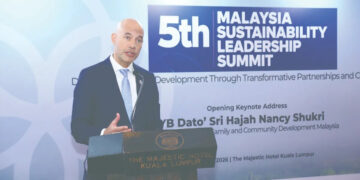


KUALA LUMPUR: While the world remains off track to meet the United Nations Sustainable Development Goals (SDGs), Malaysia is making comparatively strong progress towards its targets.
United Nations Resident Coordinator for Malaysia, Singapore and Brunei Darussalam Nikolas Myint said 58% of the country’s targets are on track, but 29% remain off track, and 13% lack sufficient data to judge.
“With less than four years remaining until 2030, the latest UN assessment shows that only about one-third of SDG targets are on track or are making moderate progress.
“Another third are making only marginal progress. And a final third are stagnant or moving backwards.
“So we have gaps left to close and needs to be met. But in those gaps are opportunities. We must redouble our efforts, identify what works, and come together to scale successful solutions,” he told delegates at the 5th Malaysia Sustainability Leadership Summit 2026 recently.
Nikolas said governments can drive progress towards the SDGs – and Malaysia is a case in point for what is possible when a government focuses on advancing the SDGs through measurement, financing, and policy.
“But governments can only go so far. Businesses play a critical role — by creating jobs, investing capital, developing technologies and driving innovation,“ he said.
Nikolas said the SDGs were never 17 separate boxes and were designed as mutually reinforcing pathways.
“Our implementation must reflect that. So we need to move: From commitments to delivery. From pilots to scale. From ambition to implementation. And from individual projects to systemic change,“ he said.
He said more growth is needed. Globally, 1.2 billion people are forecast to enter the labour market over the next decade, but on current trends, only 400 million jobs will be created.
“So we need a different kind of growth that creates jobs and raises incomes and improves productivity. Not growth versus sustainability but growth through sustainability.
“We can mobilise capital. Create incentives. And take solutions to scale. And the countries that find, develop, and execute these solutions will create blueprints for a sustainable future, markets for their companies, and demand for their services,“ he said.
Nikolas sees the opportunity in Malaysia, with close connections between the private and public sectors.
He said that in a space where the private sector plays a meaningful and constructive role in identifying and executing win-win opportunities, Malaysia can develop and deliver that new kind of growth.
“We need investment that makes the transition possible. Regulation that provides certainty. Innovation that reduces the cost of transition. Finance that rewards sustainable choices.
“And partnerships that share risk where markets alone cannot. There is a major opportunity here. The transition to a low-carbon economy can create new industries, technologies, jobs and markets,“ he said.
Government can lead and create the enabling environment, business can bring investment, innovation, technology and scale – and contribute to a fair labour market and a more inclusive economy, and communities bring knowledge of what is actually happening on the ground. And the United Nations can help connect these strengths, Nikolas said.
“We need to be brave in policy and change policies that no longer serve the future we want. Remove barriers to sustainable investment and make difficult choices today for benefits that may only become visible tomorrow.
“Be brave in business and invest ahead of the curve. Look beyond the next quarter. See sustainability not as a compliance cost, but as a source of resilience, innovation and competitive advantage. Be brave in finance.
“Direct capital towards the transitions Malaysia needs. Reward long-term value. Find new ways to finance solutions that are good for people and for nature. And be brave in partnership.”