

RM
‘;p.style.left=(42+Math.random()*56)+’%’;p.style.setProperty(‘–d’,(6+Math.random()*4).toFixed(1)+’s’);p.style.setProperty(‘–delay’,(-Math.random()*9).toFixed(1)+’s’);p.style.setProperty(‘–r0′,(-25+Math.random()*20).toFixed(0)+’deg’);p.style.setProperty(‘–r1′,(10+Math.random()*40).toFixed(0)+’deg’);p.style.setProperty(‘–s’,(0.8+Math.random()*0.6).toFixed(2));box.appendChild(p)}}
if(‘IntersectionObserver’ in window){new IntersectionObserver(function(entries){entries.forEach(function(e){banner.classList.toggle(‘b27-paused’,!e.isIntersecting)})},{threshold:0.1}).observe(banner)}})})()
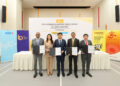
KUALA LUMPUR: Selangor has attracted proposed investments worth more than RM3 billion from four foreign investors in the biotechnology, data centre, new energy and environmental technology sectors, with letters of intent (LoIs) submitted at the opening of the Selangor International Business Summit 2026 (SIBS 2026) today.
The LoIs were presented to Invest Selangor Bhd, facilitated by UOB Malaysia, and involved Shenghui Biotechnology (Malaysia) Sdn Bhd, Galaxy Data Centre, XTC New Energy and Wuxi Weifu Environmental Catalysts Co Ltd.
Invest Selangor said the LoIs reflected the investors’ interest in exploring business and growth opportunities in the state.
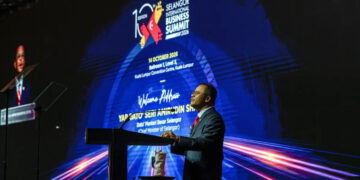
In his speech at the opening ceremony, Menteri Besar Datuk Seri Amirudin Shari said Selangor was steering its industrial base towards advanced automation, life sciences, green technology and cutting-edge digital infrastructure.
He emphasised that the state was no longer interested in competing on the basis of the cheapest labour, but instead wanted to attract investors seeking skilled talent, advanced technology and long-term partnerships.
“If you are looking for cheap land or cheap labour, Selangor is not the place. But if you want to develop long-term partnerships and want Malaysia’s brightest minds as your workforce and development team, I urge you to look at Selangor,” he said.
Amirudin disclosed that Selangor was targeting higher-value segments of the semiconductor supply chain, particularly front-end integrated circuit (IC) design, electronic design automation (EDA) and intellectual property creation, as the state seeks to move beyond low-margin manufacturing activities.
He added the state’s industrial transformation was aimed at shifting its economic trajectory from manufacturing products to developing more sophisticated technology and intellectual property.
“Our transition is deliberate: we are shifting our trajectory from ‘Made in Malaysia’ to ‘Designed and Engineered by Malaysia’,” he said, describing the transition as a key challenge for Selangor over the next decade.
Amirudin cited the Malaysia Semiconductor IC Design Park in Puchong as a concrete example of the state’s efforts to strengthen its position in the semiconductor value chain.
“We are not waiting for technology transfer to trickle down; we are building the incubators, providing the high-performance computing infrastructure, and upskilling local engineers to design world-class chips right here on Selangor soil,” he said.
“We want the next generation of semiconductors powering global artificial intelligence to be conceived, developed, and brought to life in this state.”
Amirudin said these efforts were part of a broader strategy to steer Selangor’s industrial base towards advanced automation, life sciences, green technology and cutting-edge digital infrastructure.
The strategy reflects the state’s ambition to participate in higher-value activities as demand for semiconductors grows alongside the development of artificial intelligence, electric vehicles, renewable energy systems and cloud computing infrastructure.
Amirudin stressed that Selangor’s economic resilience depended on regional cooperation, rather than competition among neighbouring economies for investment. “Economic resilience cannot be built in isolation. True prosperity is relational; it thrives when regional neighbours collaborate rather than compete in a zero-sum race to the bottom.”
He called for greater regional cohesion and a shared approach to economic development, arguing that Asean’s collective growth should benefit all its member countries. “We have to be a team, united to achieve collective growth which will benefit all 11 countries in the region, including our newest member Timor Leste.”
Amirudin said Malaysia, including Selangor, was well positioned to contribute to this regional effort as Southeast Asia attracts greater international attention for its market access, workforce and growth opportunities.
Selangor would also need to help its small and medium enterprises expand beyond domestic markets and become more competitive across Southeast Asia.
“For the next 10 years, our challenge is two-fold; broaden our horizon to Asia, and help Selangor’s SMEs make the next great leap to compete with the best in Southeast Asia,” Amirudin said.
SIBS 2026, organised by Invest Selangor and hosted by the Selangor state government, opened yesterday and runs until Saturday at the Kuala Lumpur Convention Centre under the theme “Selangor, the Gateway to Asean”.
The four-day summit features 526 exhibition booths and targets 50,000 visitors and RM8 billion in potential transaction value. It also involves 110 hosted delegates and 188 speakers across nine specialised conference programmes.
Marking its 10th anniversary, the summit has expanded into seven components covering regional business discussions, investment opportunities, industrial parks, artificial intelligence, semiconductors, healthcare, technology and talent development.
These include the Selangor Asean Business Conference, Selangor Investment Forum, Selangor Investment and Industrial Park Expo, Selangor AI and Semiconductor Summit, Selangor International Care Expo, Selangor Techsphere Summit and Selangor Career Outreach Talent Expo.
The opening ceremony was attended by Raja Muda Selangor Tengku Amir Shah Ibni Sultan Sharafuddin Idris Shah Alhaj, alongside state government officials, business leaders and industry representatives.