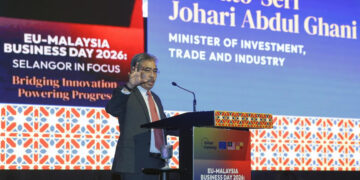


KUALA LUMPUR: Malaysia is targeting to conclude negotiations on a free trade agreement (FTA) with the European Union (EU) before the end of June 2027, with about 80% of the issues settled to date, said Investment, Trade and Industry Minister Datuk Seri Johari Abdul Ghani.
He expressed confidence that both sides could resolve the remaining differences, which include palm oil and automotive-related matters.
“I would say almost 80% already done. Both parties agree. Only the 20% that has something to do with the EU and something to do with us. I think we should be able to resolve that,” he told reporters at the EU-Malaysia Business Day 2026: Selangor in Focus today.
Johari said the agreement would give businesses in Malaysia and the EU greater access to each other’s markets, creating opportunities for trade and investment.
“At the end of the day, when we sign the FTA, the idea is there will be a free access market between both countries, ours and the EU, the EU with us. The more that we have very open markets, we are able to access, the better for us,” he added.
Johari said the agreement would be Malaysia’s 18th free trade agreement.
He disclosed that compliance with the EU Deforestation Regulation (EUDR) was not a red line for Malaysia, pointing to efforts by major plantation groups to prepare for the requirements.
Johari named United Plantations, Sime Darby, Kuala Lumpur Kepong Bhd and IOI Corporation among the companies working towards compliance. He said six or seven major producers accounted for about 60% of Malaysia’s crude palm oil output, which he put at around 20 million tonnes annually.
The regulation requires companies placing relevant commodities and products on the EU market to meet requirements aimed at ensuring they are not linked to deforestation. Compliance involves demonstrating that products meet the applicable requirements, including through traceability and due diligence.
Johari said Malaysian producers were already preparing to meet the EU’s requirements ahead of the finalisation of the implementation framework.
The European Commission’s latest account of the negotiations indicated slower progress on services and investment, export duties, motor vehicles, geographical indications and raw materials.
Negotiations began in 2010 but were suspended in 2012 before resuming in January 2025. The EU held its fifth negotiating round in September, with the sixth round scheduled to take place in Malaysia in January. More than half of the product-specific rules-of-origin chapters have been agreed, according to the commission.
EU Commissioner for International Partnerships Jozef Síkela commended Malaysia’s efforts to comply with the EUDR, saying the delay in its implementation was driven partly by pressure from other partner countries that were not yet meeting the requirements.
“I have to congratulate Malaysia for the leadership in this area. This is really true that Malaysia delivered a huge effort in order to comply,” he said.
Síkela highlighted a planned investment by Dutch semiconductor company NXP Semiconductors in Malaysia, involving about €950 million (RM4.34 billion) in investment and up to €429 million in financing from the European Investment Bank.
The expansion of NXP’s semiconductor operations in Petaling Jaya includes an additional 500,000 sq ft of space.
Production ramp-up is expected to begin in the second quarter of 2028, with output at the site expected to more than double when the expansion reaches full capacity.
The project was presented as an example of the EU’s Global Gateway strategy to support industrial development and strengthen economic partnerships.
“The NXP investment is not only about expanding production capacity; it’s about creating skilled jobs, developing advanced capabilities, strengthening Malaysia’s industrial ecosystem, and helping the country capture more value,” Síkela said.
Semiconductors were essential to artificial intelligence, clean technology, automotive manufacturing and digital infrastructure, he said, adding that Malaysia was on its way to becoming “a real global semiconductor superpower”.
Síkela also highlighted opportunities for cooperation in renewable energy, the Asean power grid, digital connectivity, advanced manufacturing and sustainable technologies, including the development of Lumut Maritime Industrial City.
He said closer cooperation between Malaysia and the EU was important amid geopolitical uncertainty and changes in global trade.
He emphasised that the EU wanted to work with Malaysia as a partner rather than impose its priorities.
Malaysia and the EU recorded €48.9 billion in bilateral goods trade in 2025, according to the European Commission. Malaysian exports to the bloc totalled €30.3 billion, while imports from the EU amounted to €18.6 billion.
Separately, EU ambassador Rafael Daerr said Malaysian exports to the EU rose 28% in the first half of 2026, while imports from the bloc increased 12% over the same period.