


ACCORDING to the Oxford Language Club, “a storm in a teacup” is an idiom that describes a situation where a small issue is blown out of proportion, thus creating unnecessary drama.
The essence of the phrase lies in exaggeration while emphasising the insignificance of the problem at hand.
Well, it seems a similar storm is brewing in a coffee cup with Threader Perak Oghang (@perakoghang) seemingly taking great offence at the fact that the menu at Oriental Kopi outlets is printed in English and Mandarin.
Aside from generic descriptions such as “nasi lemak” and “rendang”, the national language is conspicuous by its absence in the menu of the popular Malaysian Nanyang-style kopitiam chain
Taking a pot shot at the public listed eatery founded by Datuk Calvin Chan Jian Chern (alongside co-founders Chan Yen Min and Koay Song Leng) in 2020, the poster could not hide his contempt at a Malaysian brand that did not see fit to use the national language in its menu.
“Only in Malaysia can the national language be relegated to a third language,” he lamented. “People claim to be born in Malaysia but it’s the language of the mainland Motherland – not place of birth – that is championed.”
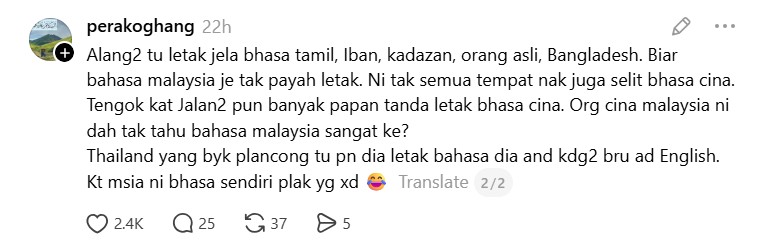
Unable to contain his ire, it was also sarcastically surmised that “Tamil, Kadazan, Orang Asli, Bangladeshi languages be used in place of Bahasa Malaysia (BM)”.
This was when the poster further claimed that the Chinese tended to take every opportunity to inject Chinese language such as in street signs. Even in tourist-friendly Thailand, the national language is prioritised, it was argued.
“Have Malaysian Chinese completely forgotten how to use BM?” was the barbed enquiry.
Mooting boycott option
The bone-picking linguist’s post has generated a whooping 17.9K likes, 920 comments, 2.8K re-posts and 720 shares at time of writing, denoting that it is a topic that many are keen to offer their two sen worth.
Editor’s Note: Interestingly, Oriental Kopi’s founder Calvin Chan has applauded the poster for his concern while revealing that the coffee chain which currently boasts 29 outlets nationwide (with three more in Singapore) is “in the process of introducing a new menu design that also includes BM!”
“We humbly request a little time to carry out these improvements. 🙏” pleaded the business owner.
“Oriental Kopi is for all Malaysians regardless of race and background. We ‘ll continue to strive to bring honour to Malaysia through the food of our national heritage. Thank you for helping us become better! ❤️🙏”
On the one hand, there were those firmly in the rightist camp who clearly see this as another insult to the sanctity of the national language.
“Finally, there’s someone willing to highlight this matter,” harrumphed Entomologist yang berlari (@pakcik_nyamuk). “If it (Oriental Kopi) wants to be labelled a Malaysian enterprise, then it must use the national language.”

“This is Malaysia, not China” decried one citizen who felt there was no need to include Mandarin on the menu while calling on the restaurant chain to fix the situation.
However, it was contended that despite the hue and cry, Malays continue to be the biggest patrons.
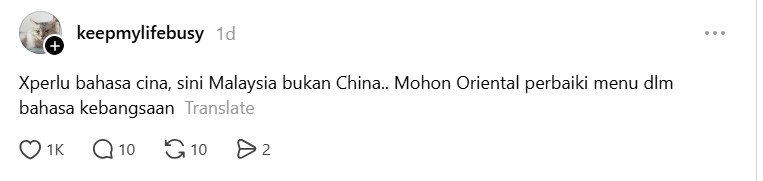

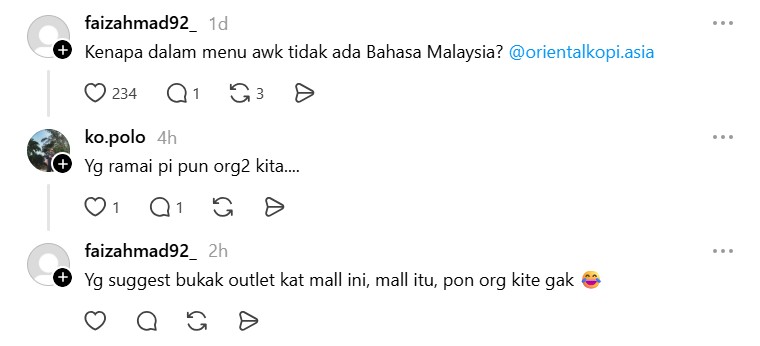
“Too soft with outsiders.” The rightist tone of one commenter was clear for all to see with accusations of unpatriotic behaviour hiding behind messages of harmony.

On the other hand, there were those who did not see what the big fuss was all about. After all, despite KFC’s menu was also in English, there seems to be no complaints there, wondered one perplexed observer.
“Was it because Oriental Kopi’s menu featured Mandarin that is causing so much consternation?”
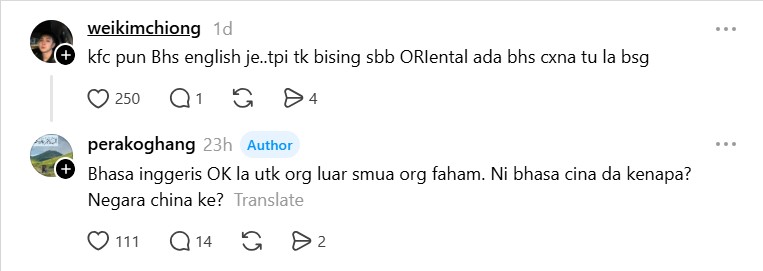
Such sentiment was echoed by this commenter who steadfastly insisted that the business themselves retain the right to choose how they wish to present themselves.
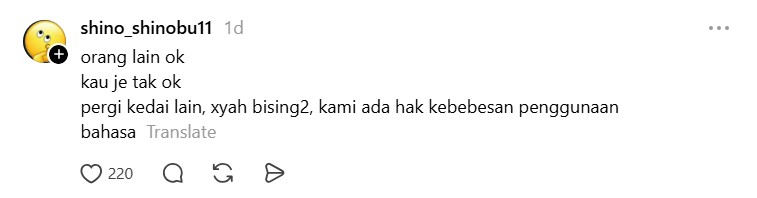
It was also suggested that the menu was not done in BM due to translation issues. “How do you translate ‘chicken hor fun’?” was a recurring question.

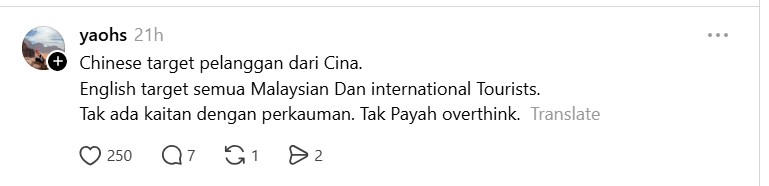
“Don’t overthink it” came a helpful suggestion. It was surmised that the menu used the languages to target specific markets without any racial undertones.
“Mandarin is used for their target Mainland Chinese (even Hong Kong and Taiwanese) customers while English is for the convenience of Malaysian and international tourists,” justified one Yao Hsien Lau (@yaohs),
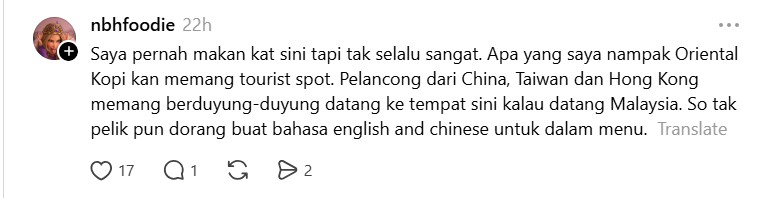
Even then, a commenter unleashed the boycott threat which is deemed a dominant weapon within the rightist fraternity.
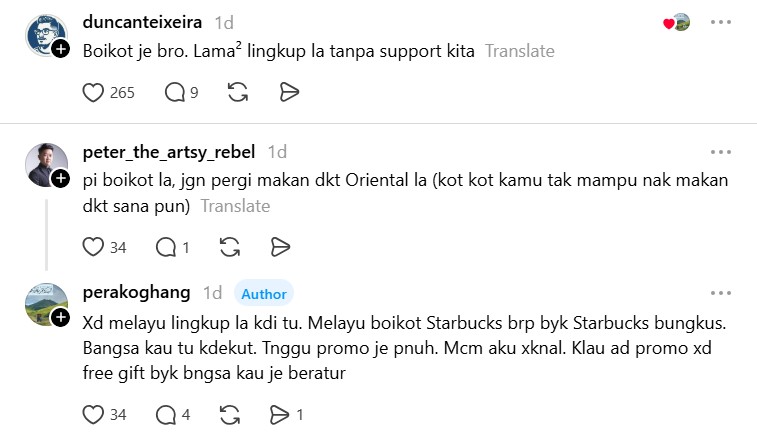
It can be argued that the poster is trying to subtly stir up 3R (race, religion and royalty) emotions by turning Oriental Kopi’s menu into a new cause celebre.
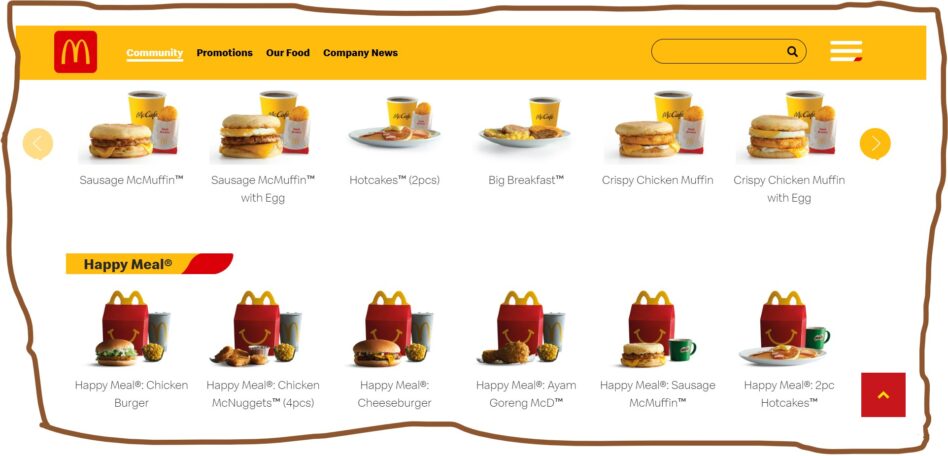
As rightly pointed out, why target Oriental Kopi alone when the menus of fast-food chains like KC and McDonalds are also predominantly in the English language.
On the flipside, it really isn’t too difficult to do, is it? The continued and wilful non-use of the national language is something that shouldn’t be up for discussion.
If a Swedish manufacturer of flat-packed, budget-line furniture can do it, there really isn’t any excuse, is there? – Oct 14, 2026